


 PLATFORM UPDATE:

Modulation of energy barriers and reaction pathways via dual-ligand engineering for enabling efficient NO removal and hydrogen production

Abstract
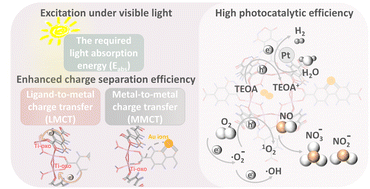
Rational modulation of organic ligands in MOFs enables precise control over both the light absorption capability and charge carrier transfer pathways, thereby significantly optimizing the photocatalytic activity. In this work, we strategically incorporated Au ions chelated with 2,2′-bipyridine-5,5′-dicarboxylic acid (DPDC) into NH2-MIL-125 during the synthesis process, which simultaneously improved the light-harvesting efficiency and established additional metal-to-metal charge transfer (MMCT) channels to enhance the charge carrier separation efficiency. Furthermore, the Au ions anchored to the bipyridine nitrogen in conjunction with Ti-oxo clusters could serve as additional active sites for photocatalytic reactions. The resulting dual-ligand NM125-D-A exhibited exceptional bifunctional photocatalytic performance, achieving 65.04% NO removal efficiency (3.4-fold enhancement) and a remarkable hydrogen production rate of 4773.50 μmol g−1 h−1 (4.8-fold improvement) compared to the original NH2-MIL-125. Comprehensive mechanistic investigations employing electron spin-resonance spectroscopy, in situ DRIFTS, and density functional theory calculations elucidated the reactive intermediates and proposed plausible photocatalytic pathways. This work successfully demonstrated an effective dual-ligand modulation strategy to develop excellent light responsive MOF photocatalysts with a tailored charge transfer mechanism for environmental and energy applications.
 Please wait while we load your content...


