


 PLATFORM UPDATE:


Design of novel bismaleimide-based single-ion conducting hybrid electrolytes for high ionic conductivity and extended cycling stability lithium-metal batteries
 *a
*a
Abstract
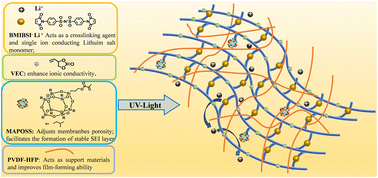
Solid polymer electrolytes offer the advantage of significantly enhancing the safety of lithium metal batteries compared with traditional liquid electrolytes. However, their practical application is often limited by inherently low room temperature ionic conductivity, low lithium-ion transference numbers and poor interfacial compatibility. In this work, a novel lithium bis(4-maleimidophenyl)sulfonylimide monomer (Li-BMIBSI) was designed and synthesized for the construction of POSS hybrid porous crosslinked bis(maleimide)-based single-ion conductor polymer electrolytes (Px-BMI-SCPEs), which were obtained through copolymerization of Li-BMIBSI, vinylethylene carbonate (VEC) and heptaisobutyl methacrylate POSS (MAPOSS) in the presence of PVDF-HFP by adjusting the weight ratio of POSS. Here, the sulfonyl imide groups are highly delocalized and effectively lower the lithium-ion dissociation energy barrier, while the VEC groups interact with lithium ions through their carbonyl groups, constructing high-speed ion transport channels. The results demonstrated that POSS incorporation could regulate polymer pore formation while enhancing the mechanical strength of the porous membrane framework. These Px-BMI-SCPEs exhibit a superior tLi+ of 0.80, high ionic conductivity of 1.58 × 10⁻⁴ S cm−1, and extended electrochemical window of 5.2 V. Moreover, Px-BMI-SCPEs exhibit good electrolytes/electrode interfacial compatibility. XPS results reveal the formation of a highly stable solid-electrolyte interphase (SEI) at the lithium anode interface, composed of beneficial inorganic components (LiF, Li2CO3, and LixSiOy) along with organic C–F species, which collectively enable uniform lithium deposition and effectively suppressed dendrite growth. These superior material properties enable exceptional battery performance: Li‖Li symmetric cells maintained stable cycling for over 1000 hours at 0.1 mA cm−2, while Li‖LiFePO4 cells exhibit excellent cycling stability with capacity retention exceeding 90% after 200 cycles at 0.5C rate. This work offers novel insights into the structural design and performance optimization of single-ion conducting polymer electrolytes.
 Please wait while we load your content...


