


 PLATFORM UPDATE:


Colloid-like MXene/phenolic resin composite films with multi-interface architectures for enhanced light-to-heat conversion

Abstract
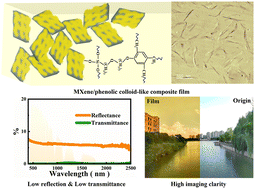
Designing complex multi-interface architectures on photothermal materials—to enhance internal light reflection and absorption while reducing surface reflection—has proven to be an effective strategy for improving light-to-heat conversion efficiency. In this study, a colloid-like thin film with superior photothermal performance was fabricated via a facile method by incorporating γ-glycidoxypropyltrimethoxysilane (GPTS)-modified MXene (S-MXene) into a phenolic resin matrix. The phenolic resin underwent in situ crosslinking with the GPTS modifier grafted on the MXene surface and was rapidly cured under heat, allowing the nanosheets to retain their colloidal dispersion state even within the solidified matrix. In this system, the uniformly dispersed and well-exfoliated S-MXene nanosheets fully exploited their inherently large specific surface area, forming abundant interfaces with the resin matrix. These interfaces facilitated efficient light capture and enhanced light-to-heat conversion via internal multi-interface reflection. Colloid-like films containing 5 wt% of the modified filler and having ∼30 μm thickness exhibited high light-to-heat conversion efficiency (94%) along with favorable optical properties, including negligible transmittance, reflectance below 5%, and imaging clarity comparable to that of colloidal dispersions. Additionally, effective medium theory calculations confirmed that the films exhibited light absorption behavior similar to that of homogeneous or colloidal systems. Furthermore, the encapsulating resin markedly suppressed MXene oxidation, enabling the films to retain over 80% of their initial temperature rise under solar irradiation after six months of ambient exposure. This work presents a scalable and robust strategy for fabricating colloid-like MXene–resin composite films with promising applications in anti-glare coatings, thermal insulation, wearable electronics, and optoelectronic devices.
 Please wait while we load your content...


