


 PLATFORM UPDATE:


Tracking phase transformations in LiMn1.5+xNi0.5−xO4 by high resolution X-ray diffraction
 *a
and
*a
and
Abstract
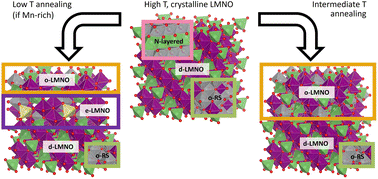
The stability and structural aspects of three categories of quenched and annealed LMNO samples, representing different stages in the processing of realistic materials, were studied by synchrotron powder X-ray diffraction and Raman spectroscopy. The complex Li–Mn–Ni–O energy landscape opens for coexistence of up to five phases under non-equilibrium conditions. These were evaluated by Rietveld refinements, assisted by lattice parameter – composition correlations, which quantitatively confirmed the nominal bulk composition. Mn/Ni cation diffusion occurs at much lower temperatures (400 °C) than previously anticipated, evidenced by Mn/Ni cation ordering in LMNO and by the (back-)formation of rock salt (o-RS) and N-layered impurity phases. Raman data reveals local Mn/Ni ordering well before the formation of domains detectable by X-ray diffraction. The formation of o-RS and Mn/Ni ordering occurs within the same temperature window. We find that o-RS is most likely the cause for oxygen release, without formation of O-vacancies in the parent spinel. A Mn-enriched e-LMNO spinel phase can form at low temperature alongside the ordering process and back-transformation of Ni-rich impurities. Such Mn/Ni segregations are the main cause of Mn(III) formation in LMNO electrodes. The described procedure provides a basis for detailed analysis of practical LMNO materials, emphasizing that the o-RS phase must be considered an integral part of all such analyses. Operando SXRD data further show that ordered and disordered LMNO can be distinguished during cycling, that tetragonal variants form at deep discharge, and that o-RS remains largely undetectable due to its small amount.
 Please wait while we load your content...


