


 PLATFORM UPDATE:

High-concentration aqueous synthesis of salicylate-based metal–organic frameworks

Abstract
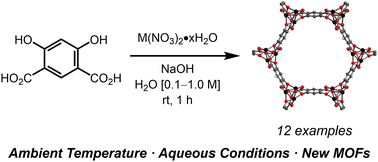
A current barrier to the practical applications of metal–organic frameworks (MOFs) is the vast quantity of organic solvents required for their preparation under dilute solvothermal conditions. Herein, we report the rapid, ambient-temperature, and high-concentration (up to 1.0 M) aqueous syntheses of three families of salicylate-based MOFs: M2(dobdc) (M = Mg, Co, Ni, Zn; dobdc4− = 2,5-dioxido-1,4-terephthalate), M2(dobpdc) (M = Mg, Co, Ni, Zn; dobpdc4− = 4,4′-dioxidobiphenyl-3,3′-dicarboxylate), and M2(m-dobdc) (M = Mg, Co, Ni; m-dobdc4− = 4,6-dioxido-1,3-benzenedicarboxylate). High-concentration MOF formation is accomplished by incorporating NaOH to deprotonate the linker molecules in situ, generally avoiding the crystallization of phases with partially protonated linkers favored under high-concentration solvothermal conditions. 77 K N2 surface area measurements confirm that the MOFs (especially Zn-based frameworks) demonstrate comparable or enhanced surface areas relative to traditionally prepared materials. Furthermore, this method enables the first synthesis of Zn2(m-dobdc), which does not form under standard solvothermal conditions. This material exhibits higher CO2 uptake and ideal adsorbed solution theory (IAST) CO2/N2 selectivities compared to the canonical framework Zn2(dobdc), highlighting the utility of aqueous high-concentration methods to facilitate the discovery of porous materials with improved gas sorption properties. Overall, our findings offer a practical and general alternative to dilute solvothermal syntheses of salicylate-based MOFs, paving the way for their production and implementation in industrial settings.
 Please wait while we load your content...


