


 PLATFORM UPDATE:


Bioinspired poly(catechol sulfide) as organic cathode materials for lithium metal batteries

Abstract
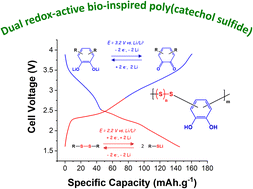
Novel bio-inspired poly(catechol sulfide) PCS copolymers with mono- and dual-redox properties are proposed for application as organic cathode materials in lithium metal batteries. Poly(catechol sulfide) copolymers were synthesized from naturally abundant catechol and sulfur, limiting their environmental footprint. These copolymers were characterized by FTIR, 1H and 13C NMR, TGA and GPC, confirming the formation of the sulfide linkage between the catechol units and their oligomeric nature. The electrochemical characterization of the PCS copolymers reveals the dual redox activity when a sulfur content of above 25 wt% is present. The catechol redox process exhibits great rate capability and cycling stability, while the sulfur redox process suffers from more sluggish kinetics due to the labile nature of the poly(sulfide) redox process (i.e. bond cleavage). Nevertheless, the PCS copolymers with either 25 or 75 wt% sulfur content display great specific energy densities of 237 Wh kg−1 and 182 Wh kg−1 at specific power densities of 10.17 kW kg−1 and 31.18 kW kg−1, respectively. These results highlight the potential of PCS copolymers as sustainable, high power and energy density organic cathode materials for lithium metal batteries.
 Please wait while we load your content...


