


 PLATFORM UPDATE:


Representation learning for long-chain hydrocarbon adsorption in zeolites
 b
Peng
Bai
*a
b
Peng
Bai
*a
Abstract
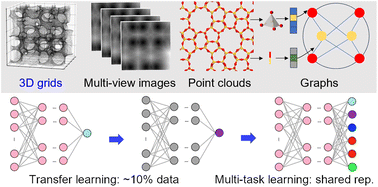
Zeolites are a class of crystalline nanoporous materials known for their ability to discriminate molecules based on size and shape. Such molecular shape selectivity arises from the precise 3-dimensional arrangement of zeolite framework atoms and the resulting non-covalent interactions. In this work, Henry's constants (kH) for n-octadecane adsorption in all-silica zeolites were used as the target property in a systematic effort to optimize and evaluate various machine-learning representations widely used for materials modeling, including convolutional neural networks (ConvNets) with 3D volumetric grids (ZeoNet, as proposed by J. Mater. Chem. A, 2023, 11, 17 570), ConvNets with 2D multi-view images, Vision Transformers with 3D volumetric grids, PointNet and EdgeConv with point clouds of atomic coordinates and solvent-accessible surface, and graph-based neural networks (CGCNN, MEGNet, M3GNet, and MACE). ZeoNet was found to vastly outperform other representations, achieving a correlation coefficient of r2 = 0.973 and a mean-squared error (MSE) of 4.4 in ln kH. In comparison, the best-performing graph model for this task, M3GNet, obtained r2 = 0.888 and MSE = 18.5, reflecting the difficulty of graph models in capturing subtle structural variations and long-ranged spatial correlations. ZeoNet also exhibited excellent transferability to other hydrocarbon molecules, including mono- and di-branched C18 isomers and linear C24 and C30 alkanes. Fine-tuning of pre-trained ZeoNet using training sets of 2100 samples can achieve the same level of performance as ZeoNet trained from scratch using over 10 000 samples. Finally, multi-task learning, which trains a single model with a shared representation and multiple prediction heads, was shown to improve the accuracy in predicting adsorption selectivity without compromising the prediction of Henry's constant for individual molecules.
 Please wait while we load your content...


