


 PLATFORM UPDATE:


Flexibly bonded lead–halogen dual sites of coordination polymers for photocatalytic C–N coupling†
 *ab
and
Jun
He
*ab
*ab
and
Jun
He
*ab
Abstract
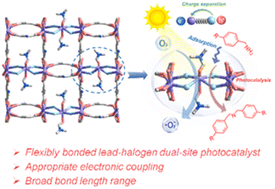
The development of dual-site catalysts characterized by balanced electronic coupling and spatial adaptability presents a significant challenge in the field of photocatalysis. In this work, we present two metal halide coordination polymers, XCP-3(Br) and XCP-3(I), which were synthesized using 2-aminoterephthalic acid (NH2-BDC) ligands in combination with PbX2 (X = Br, I). These coordination polymers possess flexibly bonded lead–halogen dual sites that work synergistically to facilitate the separation of photogenerated charges and enhance the adsorption and activation of substrates. Under aerobic conditions, XCP-3(I) demonstrates remarkable photocatalytic conversion efficiencies ranging from 81.1% to 99.9% for the oxidative C–N coupling of benzylamine compounds, significantly surpassing the performance of XCP-3(Br). This enhanced efficiency is attributed to the optimal Pb–I bond length, which effectively balances electronic synergy and spatial flexibility, thereby accommodating benzylamine substrates. This research marks the first instance of a photocatalyst employing bonded lead–halogen dual sites for C–N coupling reactions, offering a foundational design framework for catalytic systems aimed at complex organic synthesis.
 Please wait while we load your content...


