


 PLATFORM UPDATE:


Ruthenium-catalyzed dimerization of vanillin for the formation of a biobased epoxy thermoset resin†
 a
Iuliana
Ribca,
b
Namratha
Prabhu,
‡a
Josselin
Mante,
‡a
Maureen
Gumbo,
a
Andreas
Ekebergh,
*a
Mats
Johansson
*b
and
Nina
Kann
*a
a
Iuliana
Ribca,
b
Namratha
Prabhu,
‡a
Josselin
Mante,
‡a
Maureen
Gumbo,
a
Andreas
Ekebergh,
*a
Mats
Johansson
*b
and
Nina
Kann
*a
Abstract
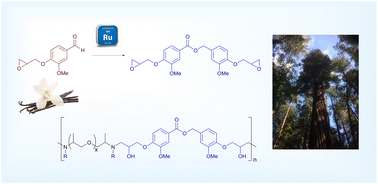
Vanillin is one of few lignin platform chemicals that are currently available on industrial scale. Seeking to find biobased alternatives to the reprotoxic compound bisphenol A (BPA), we have successfully dimerized three different monomeric vanillin derivatives in a ruthenium-catalyzed Tischenko reaction. The resulting esters were characterized by NMR, FTIR, HRMS, and single crystal X-ray diffraction. The thermal behaviour of one of these derivatives, the epoxy divanillin ester EDVE, was studied further by DSC and TGA. EDVE was subsequently applied towards the preparation of an epoxy thermoset resin via curing with Jeffamine D-400. The thermoset formulation was thermally cured, monitoring the curing with DSC and FTIR. The final thermoset was then characterized with respect to physical and mechanical properties with DSC, TGA, and DMA. This catalytic approach provides a new strategy to access vanillin-based epoxides that could potentially replace bisphenol A.
- This article is part of the themed collections: Celebrating International Women’s Day 2026: Women in RSC Sustainability and UN Sustainable Development Goal 12: Responsible consumption and production
 Please wait while we load your content...


