


 PLATFORM UPDATE:

Preparation of self-healing flexible sensing materials based on ligand–metal coordination chemistry
 *a
*a
Abstract
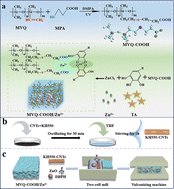
This work explores the creation of a novel self-healing material based on methyl vinyl silicone rubber (MVQ), which was functionalized with COO− groups through a thiol–ene click reaction and crosslinked with tannic acid (TA) and ZnCl2 to form a composite characterized by ionic and coordination bonds, thereby enabling self-healing. The carboxylated carbon nanotubes modified with KH550 (KH550-CNTs) were uniformly dispersed in the elastomer matrix, successfully fabricating a sensing material that combines flexibility with skin-like sensing capabilities. The results showed that the self-healing silicone elastomers had a tensile strength of approximately 0.41 MPa and an elongation at break of 868.97%. The material also demonstrated excellent self-healing capabilities (96.09% healing efficiency at 80 °C/6 h). Due to its complex porous structure, the sensor exhibited very high sensitivity, with a maximum gauge factor (GFmax) of 230. The material exhibited no significant mass loss or compositional degradation over the temperature range of 0–400 °C, as determined by TG analysis. Notably, this self-healing MVQ can be manufactured on a large scale with cost-effectiveness, thereby promoting its widespread adoption and further application across diverse industries and fields.
 Please wait while we load your content...


