


 PLATFORM UPDATE:


Instabilities in colloidal crystals on fluid membranes
 *a
and
Basant Lal
Sharma
b
*a
and
Basant Lal
Sharma
b
Abstract
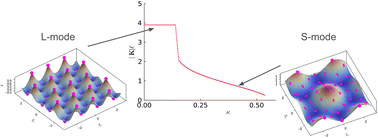
The complex physics of self-assembly in colloidal crystals on deformable interfaces and surfaces poses interesting possibilities for the synthesis of new materials. The goal of this article is to address one such aspect and characterize instabilities arising in colloidal crystals assembled on fluid membranes. The colloidal particles are modeled as pair-wise interacting point particles, constrained to lie on a fluid membrane and yet free to reorganize, and the membrane's elastic energy is modeled via the Helfrich energy. We find that when a collection of particles is arranged on a planar membrane in some regular fashion – such as a periodic lattice – then the regular configuration admits bifurcations to non-planar configurations. Using the Bloch-wave ansatz for the mode of instabilities, we present a parametric analysis of the boundary between the stable and unstable regimes. We find that instabilities can occur through two distinct kinds of modes, when the parameters belong in certain physically interesting regimes, referred to as long-wavenumber modes (L modes) and short-wavenumber modes (S modes) in the article. We discuss some connections between these results and recent experiments, as well as relationships with the open problem of budding in biomembranes.
 Please wait while we load your content...


