


 PLATFORM UPDATE:


Phosphonic acid Lewis base doping for trap passivation and stability enhancement in high-efficiency inverted perovskite solar cells

Abstract
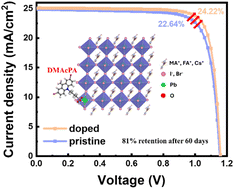
Metal halide perovskites are highly attractive for optoelectronic applications due to their exceptional optoelectronic properties. However, defect-induced non-radiative recombination and poor long-term stability continue to limit device performance. In this work, we present a Lewis base doping strategy using (4-(2,7-dibromo-9,9-dimethylacridin-10(9H)-yl)butyl)phosphonic acid (DMAcPA) to effectively passivate electron trap states in perovskite films. The phosphonic acid group in DMAcPA coordinates with undercoordinated Pb2+ ions, thereby suppressing trap-assisted recombination. This doping approach results in a 77% reduction in electron trap density, a fourfold enhancement in carrier lifetime, enlarged grain size, and improved film crystallinity. As a result, inverted (p–i–n) perovskite solar cells incorporating DMAcPA achieve a power conversion efficiency of 24.22% and exhibit excellent ambient stability, retaining 81% of their initial efficiency after 60 days. These findings demonstrate the potential of molecular-level doping with phosphonic acid-functionalized compounds as a general strategy for defect mitigation and performance enhancement in perovskite photovoltaics.
 Please wait while we load your content...


