


 PLATFORM UPDATE:


In situ surface manipulation Mn-based Prussian blue analogues with enhanced redox chemistry and ion diffusion toward high-energy-density aqueous sodium-ion batteries

Abstract
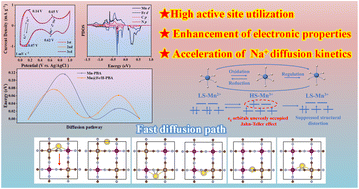
Manganese-based Prussian blue analogues (Mn-PBA) are promising cathode materials for aqueous sodium-ion batteries (ASIBs) owing to their open framework that facilitates efficient sodium ion insertion/extraction. However, their practical deployment is hindered by structural collapse arising from high-spin Mn3+ (HS-Mn3+) dissolution during cycling, triggered by the Jahn–Teller effect, which severely limits long-term stability. Here, we design an in situ chemically regulated Mn@Fe/H-PBA electrode with a hierarchical hollow structure via co-precipitation. The hollow architecture provides a large surface area for enhanced active site utilization, while the stabilized hierarchical framework enriched with low-spin Mn3+ (LS-Mn3+) effectively suppresses structural distortion. Together, these features enable Mn@Fe/H-PBA to deliver a high discharge capacity of 121 mA h g−1 at 1 A g−1 with excellent cycling durability. In situ/ex situ characterization combined with density functional theory (DFT) calculations confirm the improved redox activity and mitigated Jahn–Teller distortion. Full cells paired with a polyimide (PI) anode achieve an energy density of 74.32 W h kg−1, while pouch cells demonstrate stable cycling over 500 cycles at 1 A g−1. This work provides a robust strategy to overcome stability challenges in Mn-PBA cathodes for next-generation ASIBs.
- This article is part of the themed collection: 15th Anniversary: Chemical Science Leading Investigators collection
 Please wait while we load your content...


