


 PLATFORM UPDATE:

Precise synthesis of telechelic rodlike polyisocyanides: versatile building blocks for fabricating polymer frameworks with controllable pore-apertures
 c
and
Zong-Quan
Wu
*a
c
and
Zong-Quan
Wu
*a
Abstract
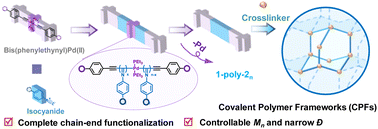
The controlled synthesis of telechelic polymers with precisely functionalized chain-ends and predictable main-chain structures is highly desirable. Herein, a series of air-stable trans-bis(phenylethynyl)palladium catalysts were designed and efficiently synthesized, which initiate the polymerization of phenyl isocyanides via a living chain-growth process, resulting in polyisocyanides with precise control of molecular weights (Mns) and narrow molecular weight distributions (Đ). The substituents of the catalyst can regulate the polymerization rate while serving as entire chain-end functional groups of the resulting polymers. Given the precise control over the length of rigid polyisocyanides, these polyisocyanides are an ideal building block for constructing covalent polymer frameworks (CPFms) with tuneable pore apertures and functionalities. As a proof of concept, water-soluble CPFs with tuneable pore-apertures were prepared and the ordering of the resulting CPFs was systematically verified by dynamic light scattering (DLS), high-resolution transmission electron microscopy (HR-TEM), and small-angle X-ray scattering (synchrotron radiation facility). Moreover, the pore aperture can be directly controlled by tuning the length of the polyisocyanide link. Owing to the tuneable pore size and charge attraction effects, the CPFs with pore apertures matching the target single-stranded deoxyribonucleic acid (ssDNA) exhibit good performance on gene delivery. The percentage of delivered ssDNA into cells is up to ca. 98% (21 and 35 units).
 Please wait while we load your content...


