


The role of transmembrane proton transport rates in mild mitochondrial uncoupling by arylamide substituted fatty acids

Abstract
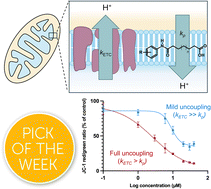
Mitochondrial uncoupling by small molecule protonophores is a promising therapeutic strategy for leading diseases including obesity, diabetes and cancer, however the clinical potential of these agents is complicated by their associated toxicity. Protonophores that exclusively produce mild uncoupling can circumvent toxicity concerns, but these compounds or a framework to guide their design is currently lacking. In this study, we prepared a series of atypical arylamide-substituted fatty acid protonophores and found that specific aromatic substitution patterns can fine-tune their uncoupling activity. Notably, 3,4-disubstituted arylamides were found to increase cellular respiration and partially depolarise mitochondria without compromising ATP production or cell viability. These are hallmarks of mild uncoupling. In contrast, 3,5-disubstituted arylamides mimicked the full uncoupling effects of the classical uncouplers DNP and CCCP. Mechanistic studies revealed a diminished capacity for the 3,4-disubstituted arylamides to self-assemble into membrane permeable dimers in the rate limiting step of the protonophoric cycle. This translated into overall slower rates of transmembrane proton transport, and may account for their mild uncoupling activity. This work represents the first exploration of how proton transport rates influence mitochondrial uncoupling and provides a new conceptual framework for the rational design of mild uncouplers.
- This article is part of the themed collections: 2025 Chemical Science HOT Article Collection and 2025 ChemSci Pick of the Week Collection
 Please wait while we load your content...


