


 PLATFORM UPDATE:

Distinct hydrogen atom transfer and radical capture reactivity of copper(iii) OH/F complexes enables site-selective C(sp3)–H 18F-fluorination
 *a
*a
Abstract
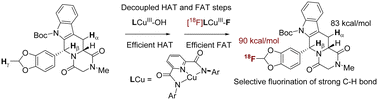
High-valent metal intermediates play a key role in C(sp3)–H functionalization reactions in both enzymatic catalysis and organometallic chemistry. Despite its generality, this strategy often requires a single metal complex to efficiently mediate both hydrogen atom transfer and radical capture—a combination challenging to achieve. To overcome this limitation, we propose a decoupled approach, where separate high-valent metal complexes independently perform hydrogen atom transfer (HAT) and radical capture (RC). As a proof of concept, we leveraged the complementary reactivity of copper(III) hydroxide (efficient for HAT) and copper(III) fluoride (efficient for RC) to develop a decoupled 18F-fluorination protocol. The distinct reactivity of copper(III) hydroxide and copper(III) fluoride not only enables precise control over the C–H activation process but also preserves the valuable [18F]fluoride for radical capture, preventing its consumption during HAT. With this mechanistic insight, we achieved the selective fluorination of α-ethereal, benzylic, and allylic C–H bonds, facilitating the synthesis of a series of 18F-labeled organic molecules.
 Please wait while we load your content...


