


 PLATFORM UPDATE:


Exciplex spin-flip acceleration enables high-performance narrowband electroluminescence
 ce
and
Chuluo
Yang
*a
ce
and
Chuluo
Yang
*a
Abstract
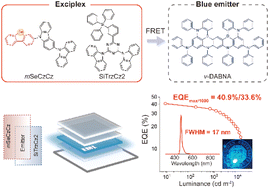
Exciplex-forming systems that harvest triplet excitons via a triplet-to-singlet spin flip (reverse intersystem crossing, RISC) enable thermally activated delayed fluorescence, providing a route to boost light emission in organic light-emitting diodes. Here, we report heavy-atom-incorporated exciplexes in which the triplet state is predominantly localized on the heavy-atom fragment, resulting in large spin–orbit coupling. Through positional isomer optimization, the RISC rate constant reaches 4.9 × 10⁶ s−1, approximately an order of magnitude higher than in typical exciplexes. Organic light-emitting diodes based on the optimized exciplex host achieve a maximum external quantum efficiency (EQE) exceeding 40% and exhibit low efficiency roll-off (EQE > 33% at 1000 cd m−2).
 Please wait while we load your content...


