


 PLATFORM UPDATE:

Structural and reactivity investigations using organo-copper(i) and zinc(ii) complexes with hydrogen and carbon dioxide†

Abstract
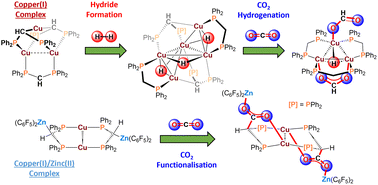
Heterogeneous copper zinc catalysts are widely used in syn-gas or carbon dioxide hydrogenation to methanol, but the structures and reactivity at the catalytic active sites are still not fully understood. Well-defined metal complexes and clusters may help reveal the structures of key intermediates, including for catalytic reactions involving gaseous species. Here, a tri-copper(I) complex, [Cu3{µ:κ3(PPC)-dppm′}2{µ:κ2(PP)-dppm′}] 1 (dppm′ = [(Ph2P)2CH]−) is used as the starting point to investigate reactivity with hydrogen and carbon dioxide in solution and at low temperatures (20–60 °C) and gas pressures (1 bar or lower). Complex 1 reacts with hydrogen to afford a copper-hydride cluster, [Cu5(µ-H)(µ3-H)2(µ:κ3(PPC)-dppm′)2(µ:κ2(PP)-dppm)2] 2, which contains five CuI centres and three hydrido ligands. The reaction of 2 with carbon dioxide provides a tri-copper(I)-bis(formate)(hydrido) complex, [Cu3(µ3-H)(κ1(O)-O2CH)(µ:κ2(OO)-O2CH)(µ:κ2(PP)-dppm)3] 3, in which two molecules of carbon dioxide react with the hydrides to produce formate ligands. Treating 1 with an organozinc(II) complex, [Zn(C6F5)2], affords a hetero-tetrametallic CuI2ZnII2 complex, [Cu2(µ:κ3(PPC)-dppm′)2{Zn(C6F5)2}2] 4. Complex 4 features two cationic Cu(I) and two anionic Zn(II) centres, adopting an unusual copper zincate speciation, and reacts with carbon dioxide to form a bis(carboxylate)-CuI2ZnII2 complex, [Cu2(µ:κ4(PPOO)-dppm″)2{Zn(C6F5)2}2] 5; carbon dioxide inserts into the Zn–C bond and forms a new C–C bond with the methine carbon of the dppm′ ligand. Overall, the structures and reactivity indicate that CuI sites readily form hydrides, on exposure to hydrogen; these cuprous hydrides react with CO2 to produce formate, and cuprous zincates react with CO2 to afford carboxylates.
 Please wait while we load your content...


