Issue 47, 2025

Understanding the formation mechanism of crystalline hydrated polymorphs of carbonic acid from CO2 clathrate hydrate

Abstract

Carbon dioxide (CO2) and water (H2O) icy mixtures, together with a few other simple molecules, have a prominent role in astrochemical processes. The formation of the solid 1 : 1 CO2 : H2O adduct, carbonic acid (H2CO3), has been long studied because of its importance in the biological and geochemical domains. Our recent discovery of a novel, highly reproducible synthetic path to obtain crystalline hydrated H2CO3 polymorphs from low temperature compression of CO2 clathrate hydrate highlighted the role of pressure in the chemistry of crystal ices. Herein, we report an extensive study about the reaction mechanism leading to this synthesis, unveiling a multi-step temperature-governed process that involves the formation of carbonic acid molecules starting from about 200 K and their organisation in a crystalline lattice at temperatures close to 270 K. In addition, the essential role played by the clathrate in the formation of crystalline carbonic acids is clearly highlighted, while the entire process meticulously mimics what can occur during the subduction of icy materials.
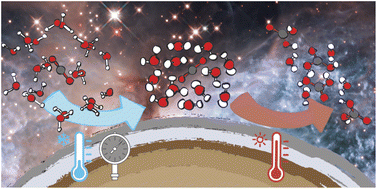
Graphical abstract: Understanding the formation mechanism of crystalline hydrated polymorphs of carbonic acid from CO2 clathrate hydrate

Supplementary files

Transparent peer review

To support increased transparency, we offer authors the option to publish the peer review history alongside their article.

View this article’s peer review history

Article information

Article type
Edge Article
Submitted
24 Mar 2025
Accepted
22 Oct 2025
First published
22 Oct 2025
This article is Open Access

All publication charges for this article have been paid for by the Royal Society of Chemistry
Creative Commons BY-NC license

Chem. Sci., 2025,16, 22769-22780

Understanding the formation mechanism of crystalline hydrated polymorphs of carbonic acid from CO2 clathrate hydrate

S. Berni, D. Scelta, S. Romi, S. Fanetti, F. Alabarse, B. Wehinger and R. Bini, Chem. Sci., 2025, 16, 22769 DOI: 10.1039/D5SC02241J

This article is licensed under a Creative Commons Attribution-NonCommercial 3.0 Unported Licence. You can use material from this article in other publications, without requesting further permission from the RSC, provided that the correct acknowledgement is given and it is not used for commercial purposes.

To request permission to reproduce material from this article in a commercial publication, please go to the Copyright Clearance Center request page.

If you are an author contributing to an RSC publication, you do not need to request permission provided correct acknowledgement is given.

If you are the author of this article, you do not need to request permission to reproduce figures and diagrams provided correct acknowledgement is given. If you want to reproduce the whole article in a third-party commercial publication (excluding your thesis/dissertation for which permission is not required) please go to the Copyright Clearance Center request page.

Read more about how to correctly acknowledge RSC content.

Social activity

Spotlight

Advertisements