


 PLATFORM UPDATE:


First-principles study of vanadium-based Half-Heusler compounds: structural, electronic, optical, and thermomechanical properties for optoelectronics

Abstract
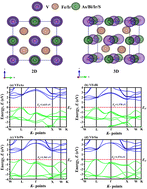
This research explores the physical properties of Half-Heusler compounds, specifically VFeAs, VFeBi, VIrPb, and VIrSn, utilizing Density Functional Theory (DFT) through the Cambridge Serial Total Energy Package (CASTEP). The study begins with structural optimization, which confirms that these compounds maintain stability within cubic crystal structures. A comprehensive analysis of their electronic band structures and density of states (DOS) reveals band gaps of 1.615 eV for VFeAs, 1.378 eV for VFeBi, 1.361 eV for VIrPb, and 1.574 eV for VIrSn, indicating that these materials exhibit semiconductor properties. To assess mechanical stability and ductility, the research evaluates the elastic constants of these compounds, which meet the Born stability criteria. The analysis of elastic moduli further indicates that VFeAs, VFeBi, VIrPb, and VIrSn demonstrate elastic isotropy. The study also analyzes key optical properties, such as the absorption coefficient, dielectric function, electrical conductivity, reflectivity, refractive index, and loss function. The findings highlight significant photoconductive behavior, high optical reflectivity, and favorable dielectric properties, suggesting that these materials hold considerable promise for use in optoelectronic devices. Moreover, the compounds exhibit low minimum thermal conductivity (Kmin) and a reduced Debye temperature (θD), making them promising candidates for thermal barrier coating (TBC) applications in cutting-edge thermal management technologies.
 Please wait while we load your content...


