


 PLATFORM UPDATE:

Reduced graphene oxide surface modification with nanoparticles and its efficiency in removing crystal violet and malachite green dyes from wastewater

Abstract
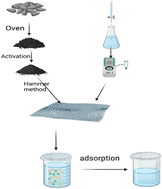
Industrial dyes are among the most complicated contaminants, posing an increasing hazard to aquatic life if left untreated. Carbon nanoparticles are extremely effective in the adsorption process. As a result, the purpose of this study was to manufacture reduced graphene oxide from sunflower husks, an affordable raw material, and modify its surface with zinc oxide and copper oxide nanoparticles that were produced in an environmentally friendly method. This improved material was employed as a sustainable adsorbent to remove crystal violet and malachite green dyes from wastewater. The results revealed that the optimal medium for adsorption was basic, with an equilibrium time of 25 minutes at 35 °C. Kinetic experiments found that the adsorption follows pseudo-second-order kinetics and is consistent with the Langmuir-Isotherm model. The thermodynamic study showed that the process is spontaneous and endothermic, with increased system randomness. Crystal violet had a removal effectiveness of 95.6%, and malachite green had one of 96% from wastewater.
 Please wait while we load your content...


