


 PLATFORM UPDATE:


Synthesis of biocompatible gold nanoparticles for photothermal therapy by mineralization using peptides

Abstract
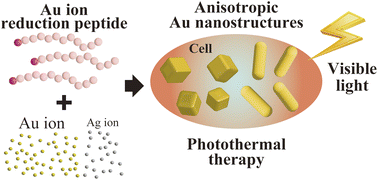
Anisotropic gold nanostructures, such as rods and cubes, exhibit unique optical properties, including absorption in the near-infrared region, which makes them highly attractive for biomedical applications such as imaging and phototherapy. However, conventional synthesis methods often require toxic surfactants and strong reducing agents, limiting their biocompatibility. In this study, we developed a method for synthesizing biocompatible gold nanostructures suitable for photothermal therapy by mineralization using peptides. We designed peptides with different numbers of tryptophan (Trp) residues at N-terminal that can reduce gold ions and control nanoparticle growth. The peptides with fewer Trp residues were found to have a red-shifted maximum absorption wavelength at lower concentrations. A 2 : 1 ratio of gold ions to silver ions was optimal for the formation of anisotropic structures. The peptides successfully imparted high dispersibility to mineralized gold nanostructures. In addition, biocompatibility testing showed no toxicity in mineralized Au nanostructures. We studied the photothermal effect of visible light irradiation on the Au nanostructures, showing that they possessed high biotoxicity under light irradiation conditions. These results suggest that this method can be used for photothermal therapy. Our peptide-based approach offers a simple, safe, and biocompatible strategy to synthesize anisotropic gold nanostructures, which could be applied to the development of future nanomedical tools.
 Please wait while we load your content...


