


 PLATFORM UPDATE:

Impact of supersaturation on growth, critical radius, and size in neomycin nanoparticle crystallization using anti-solvent and CTAB
 a
M. Reza
Malayeri
*a
and
a
M. Reza
Malayeri
*a
and
Abstract
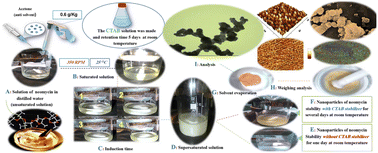
This study investigates the controlled synthesis of neomycin nanoparticles via antisolvent-induced crystallization using a water-acetone system with cetyltrimethylammonium bromide (CTAB) surfactant as a stabilizer. Comprehensive analyses, including SEM, TEM, DLS, EDS, TGA, DSC, XRD, AFM, and FT-IR, confirmed the production of nanoparticles with uniform morphology and a size distribution ranging from 22 to 265 nm. Kinetic studies revealed that higher supersaturation profoundly reduced induction time and led to the formation of nanoparticles with smaller critical sizes. Nucleation mechanism analysis based on classical nucleation theory indicated the dominance of homogeneous primary nucleation under high supersaturation conditions, directly impacting key parameters such as critical nucleus radius, crystal growth rate, and final nanoparticle size. The results also showed noticeable changes of the interfacial energy in the presence of CTAB, resulting in higher colloidal stability. Moreover, CTAB broadened the metastable zone width (MSZW), enabling more precise control over the crystallization process. Additionally, the simultaneous optimization of process parameters, including supersaturation degree, agitation rate, and CTAB concentration, achieved nanoparticles with optimal physicochemical properties. These findings represent a significant step in the development of nanopharmaceutical formulations with controlled release and enhanced therapeutic efficiency.
 Please wait while we load your content...


