


 PLATFORM UPDATE:


Strategic advances in defect-engineered Ce–Bi3YO6/rGO hybrids for rapid crystal violet mineralization under visible illumination
 *g
and
*g
and
Abstract
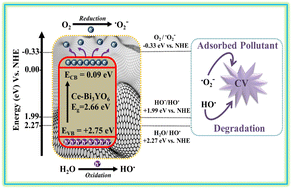
Systemically tailored cerium-doped Bi3YO6/rGO ceramic nanohybrids were prepared by a sequential hydrothermal-ultrasonication approach to surmount the innate limitations of binary metal oxides in visible-light photocatalysis, such as limited spectral absorption and fast electron–hole recombination. Incorporation of rare earths (Ce3+/Ce4+) into the Bi3YO6 lattice introduces defect-assisted carrier trapping and local band structure reconfiguration, while conductive wrapping with rGO forms an interconnected network of charge transport, enabling spatial electron migration and thus recombination suppression. Comprehensive physicochemical characterization by XRD, FTIR, TGA, and SEM; optical studies (UV-vis, PL); and electrical/electrochemical analyses (I–V, EIS, transient photocurrent) evidenced crystalline cubic Bi3YO6 with a flake-like morphology, a narrowed bandgap from 2.74 to 2.56 eV, superior light harvesting capability, and reduced interfacial resistance in the hybrid photocatalyst compared with its pristine counterpart. Under visible-light irradiation (λ > 420 nm), the optimized Ce–Bi3YO6/rGO displayed excellent photocatalytic activity toward crystal violet degradation, yielding 92.04% removal (k = 0.0800 min−1), significantly higher than those of Ce–Bi3YO6 (76.28%) and Bi3YO6 (62.37%). Scavenger experiments confirmed that ˙OH and ˙O2− species dominated the oxidative pathways, further confirming the proposed radical-driven mechanism facilitated by rGO-directed electron extraction. The catalyst showed strong reusability, with efficiency retention of >84% after five cycles, thus confirming outstanding structural robustness and photochemical durability. This work develops a synergistic approach that involves defect engineering and carbon-framework incorporation to further advance Bi-based ceramic photocatalysts toward a scalable and high-performance platform for visible-light-driven wastewater remediation.
 Please wait while we load your content...


