


 PLATFORM UPDATE:


Automated fluorescence image stitching for high-throughput and digital microfluidic biosensors

Abstract
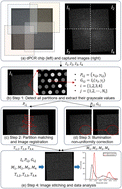
Fluorescence imaging underpins digital PCR (dPCR), microarrays, and microfluidic biosensors, yet precise image integration remains a technical bottleneck when the sample area exceeds the microscope field of view. Current stitching methods often rely on fiducial markers or manual tuning, limiting automation and robustness, particularly in portable or point-of-care devices. We present a marker-free image stitching algorithm that combines partition-detection-based registration with mask-based illumination correction. The algorithm aligns frames using intrinsic structural features and compensates for brightness inconsistencies in an adaptive manner, without requiring platform-specific parameter tuning. Application to three dPCR systems, including droplet- and chip-based formats, showed an increased number of matched feature points within overlapping regions, improving the reliability of image stitching. In addition, it enhanced intensity uniformity by ≈ 29.6% compared with conventional methods. The proposed algorithm was further validated on microarrays and bead-based chips, demonstrating consistent stitching accuracy and signal integrity across different modalities. This generalized and automation-compatible solution supports high-throughput microfluidic imaging, quantitative bioanalysis, and integration with artificial intelligence-enabled diagnostic workflows.
 Please wait while we load your content...


