Issue 58, 2025

Deciphering the donor–acceptor order: impact of acceptor positioning on the optical properties of anthraquinone-carbazole-cyanostilbenes

Abstract

We report a systematic investigation of anthraquinone–carbazole–cyanostilbene conjugates arranged in two distinct connectivity patterns: AQCZCS and CZCSAQ. Despite having identical donor and acceptor units, subtle differences in donor–acceptor ordering profoundly impact their optical and excited-state properties. Both isomers exhibit broad, structureless emission characteristic of charge-transfer (CT) states, with maxima at 635 nm (AQCZCS) and 700 nm (CZCSAQ), corresponding to a pronounced bathochromic shift (Δλ ∼65 nm). Solution-phase emission reflects connectivity-dependent shifts, confirming strong donor–acceptor communication. In the solid state, AQCZCS emits vivid orangish red (610 nm) that shifts to deep red (645 nm) upon mechanical stimulation, while CZCSAQ shows red emission that further bathochromically responds under force, highlighting the tunable mechanochromic behavior. Quantum yields of 2.7% (AQCZCS) and 1.8% (CZCSAQ) demonstrate the effect of topology on emissive efficiency. These findings establish robust structure–property correlations and provide design principles for multifunctional solid-state emitters with highly tunable CT-driven emission across the visible spectrum.
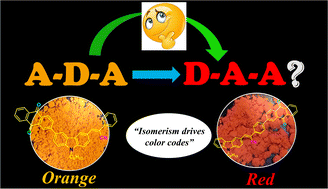
Graphical abstract: Deciphering the donor–acceptor order: impact of acceptor positioning on the optical properties of anthraquinone-carbazole-cyanostilbenes

Supplementary files

Article information

Article type
Paper
Submitted
16 Oct 2025
Accepted
10 Dec 2025
First published
16 Dec 2025
This article is Open Access
Creative Commons BY-NC license

RSC Adv., 2025,15, 50419-50427

Deciphering the donor–acceptor order: impact of acceptor positioning on the optical properties of anthraquinone-carbazole-cyanostilbenes

A. Afrin and C. A. S. P., RSC Adv., 2025, 15, 50419 DOI: 10.1039/D5RA07931D

This article is licensed under a Creative Commons Attribution-NonCommercial 3.0 Unported Licence. You can use material from this article in other publications, without requesting further permission from the RSC, provided that the correct acknowledgement is given and it is not used for commercial purposes.

To request permission to reproduce material from this article in a commercial publication, please go to the Copyright Clearance Center request page.

If you are an author contributing to an RSC publication, you do not need to request permission provided correct acknowledgement is given.

If you are the author of this article, you do not need to request permission to reproduce figures and diagrams provided correct acknowledgement is given. If you want to reproduce the whole article in a third-party commercial publication (excluding your thesis/dissertation for which permission is not required) please go to the Copyright Clearance Center request page.

Read more about how to correctly acknowledge RSC content.

Social activity

Spotlight

Advertisements