


 PLATFORM UPDATE:

Heterocyclic biradicaloid for singlet fission: cleavage of bromine atoms from precursor 3,6-dibromo-1,4-dimethyl-piperazine-2,5-dione†

Abstract
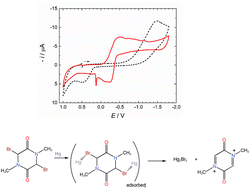
Singlet fission is a spin-allowed process, unique to molecular photophysics, whereby one singlet excited state is converted into two triplet states. The phenomenon has been observed in molecular crystals, aggregates, disordered thin films, and covalently-linked dimers. The chromophores are oriented such that the electronic coupling between the singlet and the double triplet states is large. A compound of 3,6- dibromo-1,4-dimethyl-piperazine-2,5-dione is a precursor of a dication, which is expected to yield the singlet fission effect. The reversible reductive cleavage of two C–Br bonds at −0.4 V was observed using a mercury electrode. Unexpectedly, mercury reacts by adsorptive cleavage of C–Br bonds, yielding the target product and Hg2Br2. This is a significant simplification of the preparation protocol. Voltammetry on a glassy carbon electrode showed an irreversible cleavage at ∼−1.2 V without any sign of adsorption. Spontaneous adsorptive cleavage of C–Br bonds confirms the role of the electrode material. Mechanism was confirmed by the time dependence of UV-Vis spectra, NMR technique of H,C-HMBC, and MS products analysis. The target product is highly reactive.
 Please wait while we load your content...


