


 PLATFORM UPDATE:


Machine learning-informed one-pot biodiesel synthesis from an optimally formulated mixed non-edible oil feedstock over magnetic sulfonated biobased catalyst

Abstract
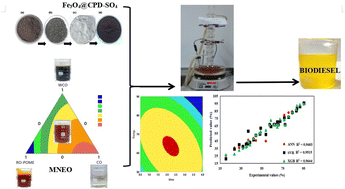
The disposal of domestic and industrial nonedible oils is a major source of environmental concern. Similarly, the global energy-related environmental crises have exacerbated over the past decade. In this research, a ternary mixture of non-edible oils (MNEO) from castor oil (CO), waste cooking oil (WCO) and recovered-oil from palm oil mill effluent (RO-POME) was optimally formulated as a feed-stock for biodiesel production. MNEO formulation was achieved using a D-optimal mixture design-aided intelligent optimization. Poultry droppings (PD) was sequentially subjected to calcination, sulfonation and magnetization to yield a reusable heterogeneous catalyst. One-pot transesterification was modeled using explainable machine learning algorithms including support vector regression (SVR), artificial neural network (ANN), and eXtreme Gradient Boosting (XGB) followed by Manta ray foraging optimization (MRFO). The optimally formulated MNEO comprised 21.31% WCO, 18.45% RO-POME, and 60.24% CO, with improved properties compared to individual oils. Fatty acid profiling of MNEO revealed it contained 29.96% (saturated), and 64.7% (unsaturated) fatty acids. Characterization results revealed the potentials of Fe3O4@CPD–SO4 in facilitating MNEO transesterification reaction. Comparative modeling demonstrated satisfactory applications of ANN, SVR and XGB, while error indices established XGB as the most superior model in capturing the complex nonlinear dynamics of the system. Feature ranking established methanol–oil molar ratio as the most influential parameter predicting biodiesel yield, underscoring the important role of methanol in biodiesel synthesis. Furthermore, optimum reaction temperature, catalyst dosage, methanol–oil-ratio and reaction time of 50 °C, 3.01 wt%, 30.0, and 2.4 h, obtained from XGB-MRFO resulted in a yield of 99.68% which was experimentally validated to be 98.16%. It is concluded that MNEO and poultry droppings can be successfully employed for sustainable biodiesel synthesis.
 Please wait while we load your content...


