


 PLATFORM UPDATE:


Development of biobased dynamic thiol–acrylate photopolymers: 3D-printed self-healing and shape memory materials
 bc
and
Sravendra
Rana
*a
bc
and
Sravendra
Rana
*a
Abstract
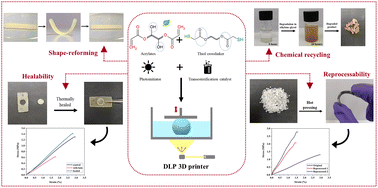
Dynamic covalent bonds have revolutionized polymer science by imparting advanced properties to the polymer networks, such as autonomous repair, reprocessability, adaptability, and shape recovery. The use of biobased precursors, such as plant-derived oils and natural monomers, further enhances the sustainability and environmental compatibility of these materials. By pairing dynamic covalent bonds with biobased precursors, 3D printing technologies can produce functional materials with both high performance and reduced environmental impact. In this study, we develop biobased thiol–acrylate vitrimers tailored for 3D printing applications, specifically targeting soft active devices with self-healing and shape-memory capabilities. Utilizing a digital light processing 3D printing technique, the resin formulation contains AESBO (an acrylated epoxidized soybean oil), a glycerol-derived reactive diluent, and a thiol crosslinker to attain tunable viscoelastic properties and dynamic bond exchange reactions within the printed object. The presence of hydroxyl–ester bonds in the thiol–acrylate network enables efficiently catalysed transesterification at elevated temperature in the presence of a tin-based catalyst Sn(Oct)2. Notably, Sn(Oct)2 functions not only as an efficient transesterification catalyst but also as a stabilizing additive that prevents premature gelation, ensuring resin shelf-stability for over two months. Experimental analysis such as dynamic mechanical analysis (DMA), reveals the significant impact of AESBO content on glass transition temperature (Tg), mechanical performance, and network adaptability. The findings from stress relaxation experiments indicate that the printed material is capable of dissipating 63% of its initial stresses within 3.6 minutes at a temperature of 200 °C, thereby facilitating self-healing and shape reformation. The materials showed promising healing, shape memory, degradability, and reprocessing capabilities, highlighting its potential for use in soft active devices and soft robotics application.
 Please wait while we load your content...


