


 PLATFORM UPDATE:


Photodecarbonylation of π-extended flavonol: mechanistic insights for PDT
 a
Pannipa
Panajapo,
c
Siramol
Photiganit,
c
Ananda
Thongyu
c
and
Kritsana
Sagarik
*c
a
Pannipa
Panajapo,
c
Siramol
Photiganit,
c
Ananda
Thongyu
c
and
Kritsana
Sagarik
*c
Abstract
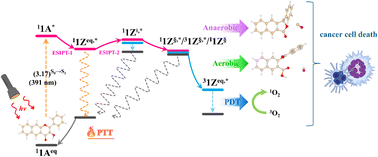
Photodynamic therapy (PDT) is a promising cancer treatment strategy, with efficacy strongly dependent on the photophysical properties and delivery of the photosensitizer. Photoactivatable carbon monoxide-releasing molecules (photoCORMs) represent a novel class of agents that enable controlled CO release, combining cytotoxic and regulatory effects in cancer cells. In this study, complementary theoretical methods were employed to elucidate the photodecarbonylation mechanism of Flavonol-1 (3-hydroxy-2-phenyl-4H-benzo[g]chromen-4-one), an organic photoCORM with potential as a dual-function photosensitizer. The DFT and TD-DFT/B3LYP/def2-TZVP approaches were benchmarked against reported photophysical data and applied to model reactions in both low- and high-dielectric environments. For the first time, double excited-state intramolecular proton transfers (ESIPTs) in the S1 state were shown to drive key acid–base reactions, with solvent polarity critically influencing the competition between fluorescence decay and intersystem crossing (ISC). In nonpolar media, low-barrier ESIPTs favor ISC, whereas in polar solvents, fluorescence of the basic form predominates, consistent with time-resolved spectroscopy. Kinetic and thermodynamic analyses revealed that aerobic pathways leading to salicylic acid ester and CO release are barrierless and energetically favorable, explaining their higher chemical yields compared to the anaerobic pathway producing lactone and CO. Crucially, intersection structures at S1/T1, S1/S0, and T1/S0 crossings were identified as reactive precursors facilitating 1O2 sensitization and CO release via rapid ISC. NVE-MDSH simulations estimated that irradiation of Flavonol-1 in an MCF-7 breast cancer cell model could elevate cytosolic temperature to the threshold for thermal necrosis. These theoretical findings suggest that Flavonol-1 could potentially act as a photosensitizer with implications for combined PDT/PTT applications, though experimental validation is required.
 Please wait while we load your content...


