Issue 57, 2025

Functional nano-nucleic acid platform promotes copper-induced gastric cancer cell death

Abstract

The targeted design of nanomedicine has revolutionized tumor therapy. We report an all-in-one ZnO@DNAzyme-Cu(II)Elesclomol nanoplatform that synchronously silences ATP7B and escorts Cu2+ to evoke cuproptosis. The DNAzyme within the nanoparticle was independently designed to target ATP7B, a key regulator of cuproptosis. This multifunctional nanoplatform can be efficiently internalized by gastric cancer cells (SGC7901), where it undergoes degradation and releases its active components. ZnO NPs act as a reservoir for zinc ions, which facilitate the catalytic activity of DNAzyme, enabling it to target and suppress ATP7B mRNA expression. Additionally, ZnO NPs reduce intracellular glutathione (GSH) levels, enhance reactive oxygen species (ROS) production, and elevate oxidative stress in tumor cells. The subsequent release of Cu(II)-Elesclomol triggers copper-induced cell death. Both in vitro and in vivo experiments demonstrated that this nanoplatform effectively inhibits tumor progression and promotes tumor cell death. This proposed nanoplatform holds significant promise for multifunctional cancer therapy and personalized nanomedicine.
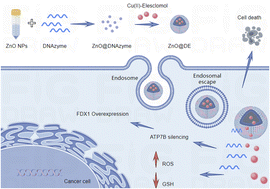
Graphical abstract: Functional nano-nucleic acid platform promotes copper-induced gastric cancer cell death

Supplementary files

Article information

Article type
Paper
Submitted
10 Oct 2025
Accepted
04 Dec 2025
First published
12 Dec 2025
This article is Open Access
Creative Commons BY-NC license

RSC Adv., 2025,15, 49643-49651

Functional nano-nucleic acid platform promotes copper-induced gastric cancer cell death

H. Zhang, B. Ding and Q. Kou, RSC Adv., 2025, 15, 49643 DOI: 10.1039/D5RA07735D

This article is licensed under a Creative Commons Attribution-NonCommercial 3.0 Unported Licence. You can use material from this article in other publications, without requesting further permission from the RSC, provided that the correct acknowledgement is given and it is not used for commercial purposes.

To request permission to reproduce material from this article in a commercial publication, please go to the Copyright Clearance Center request page.

If you are an author contributing to an RSC publication, you do not need to request permission provided correct acknowledgement is given.

If you are the author of this article, you do not need to request permission to reproduce figures and diagrams provided correct acknowledgement is given. If you want to reproduce the whole article in a third-party commercial publication (excluding your thesis/dissertation for which permission is not required) please go to the Copyright Clearance Center request page.

Read more about how to correctly acknowledge RSC content.

Social activity

Spotlight

Advertisements