


 PLATFORM UPDATE:


Synthesis, optical characterization, and antimicrobial applications of gold-coated Gd2O3:Eu3+ nanostructures

Abstract
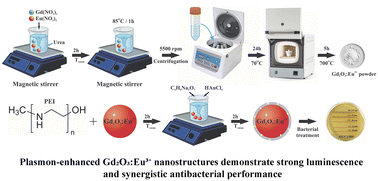
This study reports the synthesis and characterization of Eu3+-doped gadolinium oxide (Gd2O3:Eu3+) nanomaterials and their surface-modified counterparts coated with gold nanoparticles (Au NPs). A comprehensive suite of techniques, including thermogravimetric analysis (TGA), field-emission scanning electron microscopy (FESEM), high-resolution transmission electron microscopy (HRTEM), UV-Vis absorption spectroscopy, zeta potential measurements, X-ray diffraction (XRD), Raman spectroscopy, and photoluminescence were used to analysis and evaluate the synthesized samples. The SEM, TEM and XRD results revealed the successful formation of cubic-phase Gd2O3:Eu3+ with uniform spherical morphology (∼80 nm) and the homogeneous deposition of sub 10 nm Au NPs on their surfaces. The photoluminescence spectra clearly displayed the characteristic Eu3+ emission transitions (5D0 → 7Fj, j = 0–4), confirming effective doping. The introduction of Au NPs induced a surface plasmon resonance effect, which significantly enhanced the antibacterial efficacy of the nanocomposite. This was quantitatively demonstrated against a panel of clinically relevant Gram-negative and Gram-positive bacterial strains, as well as the fungal pathogen Candida albicans (Escherichia coli ATCC 25922, Staphylococcus aureus ATCC 25923, Klebsiella pneumoniae ATCC 70060, Pseudomonas aeruginosa ATCC 27853, and Candida albicans ATCC 14053). The Au-coated Gd2O3:Eu3+ samples exhibited significantly enhanced bactericidal efficiency compared to the uncoated ones. Our findings underscore the strategic advantages of coupling lanthanide luminescence with noble metal plasmonics, paving the way for a novel class of multifunctional nanomaterials with potent applications in antimicrobial therapy and biomedical diagnostics.
 Please wait while we load your content...


