


 PLATFORM UPDATE:


Cu-doped In2S3 quantum dot-CeO2 nanorod hybrid electrodes via 3D nanoprinting-inspired structuring for ultrasensitive heavy metal detection

Abstract
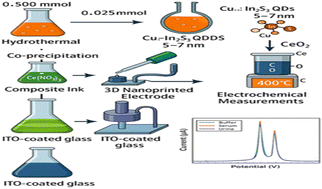
Sensitive and selective detection of toxic heavy metals in complex matrices is essential for both clinical diagnostics and environmental monitoring. Herein, we present a nanostructured electrochemical sensor based on Cu-doped In2S3 quantum dots (QDs) anchored onto oxygen-vacancy-rich CeO2 nanorods, fabricated through a 3D nanoprinting-inspired electrode structuring strategy that provides precise control over morphology and active surface accessibility. The synergistic integration of Cu:In2S3 QDs, supplying abundant catalytic sites, with CeO2 nanorods, facilitating rapid charge transfer, significantly enhanced the electrocatalytic performance toward Pb2+, Cd2+, and Hg2+ detection. Differential pulse voltammetry (DPV) enabled simultaneous monitoring with well-resolved anodic peaks (150–200 mV separation), broad linear range (0.1 nM to 50 µM), and low detection limits down to 32–60 nM. Electrochemical impedance spectroscopy confirmed reduced charge transfer resistance (∼150 Ω), consistent with accelerated interfacial kinetics. Importantly, the sensor showed strong resilience in ISO 15189-compliant artificial serum and synthetic urine, achieving recoveries of 95.5–99.0% with RSD < 4.5%. This work demonstrates how synergistic nanocomposite chemistry combined with advanced electrode structuring can deliver scalable and robust electrochemical platforms for real-time heavy metal detection in biomedical and environmental applications.
 Please wait while we load your content...


