Issue 59, 2025

Pb9Cu(PO4)6O: a room-temperature superconductor? electronic-structure features assessed via the flat/steep band model

Abstract

The recent claim of room-temperature superconductivity in copper-doped lead apatite Pb10−xCux(PO4)6O (0.9 < x <1.1) (LK-99) has stimulated widespread research, yet experimental validations consistently attribute its resistivity drops to impurities and find no evidence of zero resistivity and Meissner effect. To clarify the electronic properties of this system, we conduct systematic first-principles calculations incorporating multi-Cu doping configurations of Pb9Cu(PO4)6O beyond previously studied single substitutions. Our results demonstrate that while certain single-Cu models exhibit metallicity, all proposed structures, including double-Cu-doped supercells and c-axis chain models, display extremely narrow bandwidths (≤0.25 eV) and a lack of steep dispersive bands near the Fermi level. These features, incompatible with the flat/steep band model of superconductivity, along with the absence of characteristic electronic structures found in known superconductors, strongly suggest that LK-99 derivatives are not superconducting.
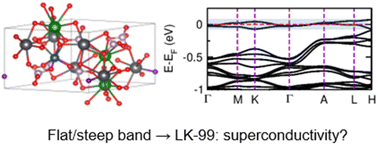
Graphical abstract: Pb9Cu(PO4)6O: a room-temperature superconductor? electronic-structure features assessed via the flat/steep band model

Supplementary files

Transparent peer review

To support increased transparency, we offer authors the option to publish the peer review history alongside their article.

View this article’s peer review history

Article information

Article type
Paper
Submitted
29 Sep 2025
Accepted
03 Dec 2025
First published
19 Dec 2025
This article is Open Access
Creative Commons BY-NC license

RSC Adv., 2025,15, 51124-51135

Pb9Cu(PO4)6O: a room-temperature superconductor? electronic-structure features assessed via the flat/steep band model

G. Liu, X. Cheng, M. Xiang, Z. Li and S. Deng, RSC Adv., 2025, 15, 51124 DOI: 10.1039/D5RA07404E

This article is licensed under a Creative Commons Attribution-NonCommercial 3.0 Unported Licence. You can use material from this article in other publications, without requesting further permission from the RSC, provided that the correct acknowledgement is given and it is not used for commercial purposes.

To request permission to reproduce material from this article in a commercial publication, please go to the Copyright Clearance Center request page.

If you are an author contributing to an RSC publication, you do not need to request permission provided correct acknowledgement is given.

If you are the author of this article, you do not need to request permission to reproduce figures and diagrams provided correct acknowledgement is given. If you want to reproduce the whole article in a third-party commercial publication (excluding your thesis/dissertation for which permission is not required) please go to the Copyright Clearance Center request page.

Read more about how to correctly acknowledge RSC content.

Social activity

Spotlight

Advertisements