


 PLATFORM UPDATE:


Green microwave synthesis of pyrazole chalcone molecular hybrids efficient route to advanced diabetes therapeutics with DNA intercalative properties
 a
and
Raj
Kaushal
*a
a
and
Raj
Kaushal
*a
Abstract
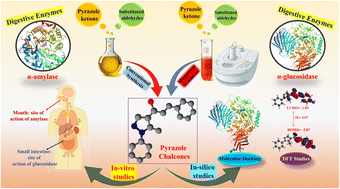
Novel chalcone derivatives incorporating pyrazole moieties were synthesized via microwave assisted Claisen–Schmidt condensation and evaluated for their in vitro α-amylase and α-glucosidase inhibitory potential as therapeutic agents against diabetes mellitus, a rapidly escalating global health crisis. The microwave-assisted approach demonstrated remarkable synthetic advantages achieving excellent yields (80–85%) and enhanced product purity within minutes compared to conventional methods requiring over 24 hours. Five pyrazole-chalcone hybrids, LI (C19H16N2O), LII (C18H14Cl2N2O), LIII (C18H14N3O3), LIV (C20H16N2O2), and LV (C18H15N2O2), were successfully synthesized from pyrazole ketone and different substituted aldehydes. Comprehensive structural characterization using FTIR, NMR, UV-Vis, fluorescence, cyclic voltammetry, and mass spectrometry confirmed successful target compound formation. In vitro enzyme inhibition studies revealed promising dose dependent activity with compounds LIV (IC50 = 212.5 µM) and LII (IC50 = 215.2 µM) demonstrating superior α-glucosidase inhibition compared to acarbose (IC50 = 240.6 µM), while compound LI exhibited potent α-amylase inhibitory activity (IC50 = 501.9 µM). DNA binding studies indicated intercalative interactions with binding constants ranging from 103 to 104 M−1. Molecular docking analysis revealed stable protein ligand complexes with compound LII showing binding affinities of −6.15 kcal mol−1 for α-glucosidase and −5.83 kcal mol−1 for α-amylase, while DFT calculations indicated HOMO–LUMO energy gaps of 3.93–4.30 eV suggesting moderate chemical reactivity. The in silico drug-likeness and oral bioavailability profiles of pyrazole-chalcone fully comply with Lipinski's criteria and exhibit excellent ADMET properties. These comprehensive findings establish pyrazole chalcone hybrids as promising multifunctional molecular scaffolds with significant potential for next-generation antidiabetic therapeutics.
 Please wait while we load your content...


