This study was aimed to synthesize new antimicrobial and antioxidant agents with increased biological efficacy due to increasing pathogenic resistance and oxidative stress. In this context, a series of thiazole-Schiff base derivatives (2a–k) were synthesized via a two-step synthetic route (Scheme 1). The structures of the synthesized compounds were characterized using analytical methods, including IR, 1H NMR, and HRMS. As part of the dual biological potential of the synthesized derivatives, in vitro antimicrobial studies were performed using the agar disc diffusion method, where 2f, 2h, and 2k showed excellent activity against both Gram-positive and Gram-negative bacterial strains. However , compound 2f exhibited the most prominent antimicrobial activity, especially as an antifungal-active derivative, with inhibitory values of 20.2 ± 0.6 mm (T. harzianum) and 32.3 ± 0.5 mm (A. niger), which were higher than those of standard amphotericin B (17.2 ± 0.6 mm and 8.0 ± 0.8 mm, respectively). Furthermore, the antioxidant activity of the synthesized compounds was evaluated by DPPH free radical assays, where compounds 2b and 2c exhibited potent antioxidant activity, with IC50 values of 31.10 ± 3.57 µg mL−1 and 14.78 ± 2.73 µg mL−1, respectively, compared with that of standard ascorbic acid (49.67 ± 4.63 µg mL−1). Complementary in silico physicochemical and pharmacokinetic properties with drug-likeness and toxicological parameters were computed and analyzed. Moreover, molecular docking studies and MD simulations were performed for the selected complexes to explore their possible binding interactions and stability.


 PLATFORM UPDATE:


 *a
and
Mohammad Mostafizur
Rahman
*a
and
Mohammad Mostafizur
Rahman 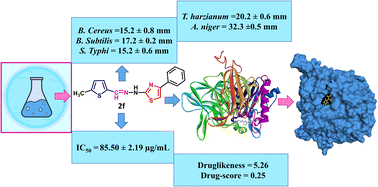
 Please wait while we load your content...


