


 PLATFORM UPDATE:


Interleaving-twisted nanoarchitectured porous organic polymer synergizes photoactivity enhancement and nanozyme-powered microenvironment remodeling for advanced infected wound therapy
 *c
*c
Abstract
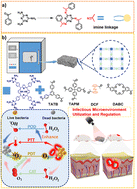
While systemic antibiotics remain the frontline defense against bacterial infections, the global antimicrobial resistance crisis urgently demands non-inducible therapeutic alternatives. Despite the inherent ability of phototherapy to bypass resistance, its efficacy in state-of-the-art porphyrin-based photosensitizers (PSs) is critically limited by aggregation-caused quenching (ACQ) of photoactivity. To overcome this dual challenge, we designed a conformation-adaptive porous organic polymer (DFP-POP). Featuring a spatially interleaving-twisting molecular architecture achieved by linking triazine–porphyrin units (H2TDPP, featuring eight amino groups) via Schiff-base polymerization with acetyl-rich bridging ferrocene (possessing a sandwich-staggered structure), DFP-POP synergizes three antimicrobial modalities to realize a cascade mechanism. This unique 3D twisted conformation inherently suppresses ACQ by preventing π–π stacking. It simultaneously facilitates broad-spectrum light absorption through extended conjugation and enables multimodal bioactivity via ferrocene-mediated enzyme-mimetic catalysis. DFP-POP orchestrates a self-enhanced multimodal therapy by manipulating oxygen in the infected microenvironment (IME). Its catalase-like (CAT-like) activity converts endogenous H2O2 to O2, alleviating hypoxia to enable self-sustaining photodynamic therapy (PDT). Additionally, its pH-responsive peroxidase-like (POD-like) activity precisely generates bactericidal ˙OH specifically within the weakly acidic IME. Consequently, DFP-POP operates through a synergistic cascade characterized by photothermal membrane disruption, hypoxia-alleviated 1O2 production, and enzyme-amplified ˙OH generation. In murine wound models, DFP-POP treatment achieved near-complete epithelialization by day 9, significantly outperforming controls. This work pioneers the integration of molecular conformation engineering with microenvironment-responsive catalytic cascades in porous organic polymer design, establishing a new paradigm for combating drug-resistant infections. The synergy between physical phototherapy and biochemical catalysis provides a blueprint for developing advanced smart therapeutic materials.
 Please wait while we load your content...


