


 PLATFORM UPDATE:


Laser-induced graphene as a versatile platform for colloidal quantum dot heterostructure photodetectors

Abstract
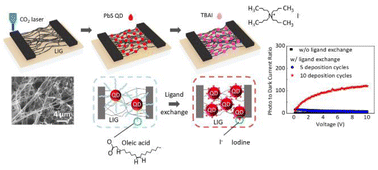
The growing demand for high-performance, flexible, and low-cost photodetectors has driven research interest in heterostructure-based architectures that integrate materials with complementary optical and electronic properties. In this study, we developed a heterostructure photodetector platform based on laser-induced graphene (LIG) and lead sulfide colloidal quantum dots (QDs). LIG, which is directly patterned on polyimide via laser irradiation, offers scalable mask-free fabrication with mechanical flexibility and excellent conductivity. To enhance charge transfer between the QDs and LIG, solid-state ligand exchange was performed, replacing the long-chain oleic acid ligands with short iodide ligands. This modification significantly improved charge transfer efficiency, resulting in a high photo-to-dark current ratio (>100), responsivity approximately 20 A W−1 with excellent linearity across a wide range of light intensities, and specific detectivity exceeding 1011 Jones. Furthermore, the versatility of LIG formation was demonstrated through its compatibility with various polyimide substrate formats, proving its potential for fabricating flexible, large-area, and customizable electrode patterns. These findings highlight the application potential of LIG-QD heterostructures as a platform for next-generation flexible optoelectronic devices.
 Please wait while we load your content...


