Issue 54, 2025, Issue in Progress

Band gap tuning and enhanced photosensitivity of nitrogenated TiO2via graphene incorporation for low-voltage UV photodetectors

Abstract

The emergence of metal oxide-based photodetectors has been on the rise in recent years, owing to the tunability of their optical band gap and photosensitivity. The current study focuses on tuning the band gap of nitrogenated TiO2 (N–TiO2) using reduced graphene oxide. The incorporation of low doses of graphene (0.0394 and 0.0432 g) into the N–TiO2 shows widening of the band gap (2.52 → 2.79 → 2.95 eV). The electrical conductivity properties obtained from the current–voltage sweep show a decrease as the graphene concentration increases and are consistent with the widening of the band gap. The photosensitivity properties of a high concentration of graphene-supported N–TiO2 depict improved response at low voltage (0.5 V) in comparison to pristine N–TiO2 by 14.7%, which suggests that graphene incorporation supports photodetection at low voltage. The study proposes that incorporating graphene into N–TiO2 nanostructures can be used to enhance the sensitivity of low-voltage UV photodetector devices.
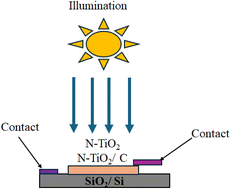
Graphical abstract: Band gap tuning and enhanced photosensitivity of nitrogenated TiO2 via graphene incorporation for low-voltage UV photodetectors

Transparent peer review

To support increased transparency, we offer authors the option to publish the peer review history alongside their article.

View this article’s peer review history

Article information

Article type
Paper
Submitted
21 Sep 2025
Accepted
18 Nov 2025
First published
24 Nov 2025
This article is Open Access
Creative Commons BY-NC license

RSC Adv., 2025,15, 46037-46047

Band gap tuning and enhanced photosensitivity of nitrogenated TiO2 via graphene incorporation for low-voltage UV photodetectors

D. O. Idisi, M. Kgomo, D. C. Chilukusha, B. W. Mwakikunga and J. K. O. Asante, RSC Adv., 2025, 15, 46037 DOI: 10.1039/D5RA07153D

This article is licensed under a Creative Commons Attribution-NonCommercial 3.0 Unported Licence. You can use material from this article in other publications, without requesting further permission from the RSC, provided that the correct acknowledgement is given and it is not used for commercial purposes.

To request permission to reproduce material from this article in a commercial publication, please go to the Copyright Clearance Center request page.

If you are an author contributing to an RSC publication, you do not need to request permission provided correct acknowledgement is given.

If you are the author of this article, you do not need to request permission to reproduce figures and diagrams provided correct acknowledgement is given. If you want to reproduce the whole article in a third-party commercial publication (excluding your thesis/dissertation for which permission is not required) please go to the Copyright Clearance Center request page.

Read more about how to correctly acknowledge RSC content.

Social activity

Spotlight

Advertisements