


 PLATFORM UPDATE:


Highly sensitive electrochemical detection of hazardous 2,4-dinitrophenylhydrazine using MgCo-TiO2/g-C3N4 heterostructure nanocomposites
 *a
*a
Abstract
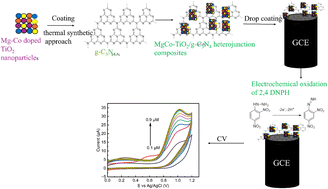
In this study, MgCo-TiO2/g-C3N4 heterostructure nanocomposites were successfully synthesized for the electrochemical detection of 2,4-dinitrophenylhydrazine. The MgCo-TiO2/C3N4 heterostructure nanocomposites were synthesized by preparing bimetal (Mg–Co)-doped TiO2 via a microwave-assisted sol gel method, followed by a thermal approach to coat it onto g-C3N4 nanosheets. The morphology, structure, composition and optical and electrochemical properties of the fabricated heterostructure nanocomposites were characterized by various analytical techniques including PXRD, UV-DRS, VB-XPS, PL, HRTEM, FESEM-EDX, FT-IR, EIS and CV. To develop an electrochemical sensor for 2,4-dinitrophenylhydrazine (2,4-DNPH), the MgCo-TiO2/g-C3N4 heterostructure nanocomposites were coated onto a glassy carbon electrode (GCE) by a drop-casting method. MgCo-TiO2/g-C3N4/GCE showed an excellent electroanalytical response for the oxidation of 2,4-DNPH in a lower pH environment. MgCo-TiO2/g-C3N4/GCE exhibited excellent selectivity, sensitivity (589.13 µA µM−1 cm−2), and a lower limit of detection (0.06 µM) in a wide linear range (0.1–0.9 µM) under optimized conditions. Furthermore, the sensor exhibited high repeatability (RSD 1.38%), reproducibility (RSD 3.57%), stability and recovery in real sample analysis.
 Please wait while we load your content...


