


 PLATFORM UPDATE:


Electrodeposition of Cu nanoparticles on TiO2 nanotubes for enhanced bactericidal effect against Escherichia coli

Abstract
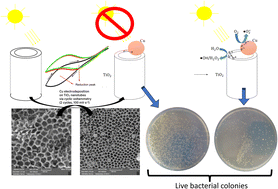
Effective and environmentally friendly disinfection methods are crucial for preventing infections and deaths. In this work, we produced anodic TiO2 nanotubes (TNTs) composited with copper nanoparticles via electrodeposition. The TNTs were prepared by two-step anodic oxidation, after which Cu nanoparticles were deposited onto them using cyclic voltammetry (CV) for 2, 3, and 5 cycles at scan rates of 20, 50, and 100 mV s−1. Field emission scanning electron microscopy (FESEM) images revealed that deposition at the highest scan rate (100 mV s−1) achieved superior nanoparticle dispersion on the TNTs compared to lower rates. Diffuse reflectance spectroscopy (DRS) and Mott–Schottky analysis indicated that the sample prepared with 2 cycles at 100 mV s−1 exhibited the best photocatalytic activity. For this optimal composite, the band gap and flat band potential were 1.68 eV and −0.579 V, respectively, compared to 3.32 eV and −0.631 V for pristine TNTs. The bactericidal activity of the TNTs and Cu-deposited TNTs was tested against Escherichia coli (E. coli) under visible light irradiation. The composite electrodeposited with 2 cycles at 100 mV s−1 exhibited bactericidal activity approximately 79.3% higher than that of pristine TNTs under visible light and 28.2% higher in the dark. This study demonstrates a cost-effective and efficient method for fabricating composites with high bactericidal performance for medical and dental applications.
 Please wait while we load your content...


