Issue 55, 2025

Design, synthesis and anti-cervical cancer activity of aroylpyrrole-based derivatives as potent histone deacetylase 6 inhibitors

Abstract

Cancers, such as cervical carcinoma, are one of the most significant diseases affecting human health and histone deacetylases (HDACs) are striking targets in current antitumor drug development. Compared to pan-HDAC inhibitors with potential toxicity, the development of selective HDAC6 inhibitors (sHDAC6is) is a major research focus. In this study, a series of derivatives bearing an aroylpyrrole core were designed and synthesized using a scaffold-hopping strategy. Among these, the best compound 4-benzoyl-1-(4-fluorobenzyl)-N-(7-(hydroxyamino)-7-oxoheptyl)-1H-pyrrole-2-carboxamide (10g) inhibited HDAC6 with an IC50 of 3.9 nM and superior selectivity over HDAC1 compared to ACY-1215. In vitro, these aroylpyrroles demonstrated promising antiproliferative activities against Hela and SiHa tumor cells. 10g also showed superior metabolic stability compared to ACY-1215 in a microsomal stability study. In summary, this work highlighted the therapeutic potential of aroylpyrrole-based sHDAC6 inhibitors and provided a valuable lead compound in treating cervical cancer.
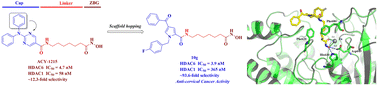
Graphical abstract: Design, synthesis and anti-cervical cancer activity of aroylpyrrole-based derivatives as potent histone deacetylase 6 inhibitors

Supplementary files

Article information

Article type
Paper
Submitted
15 Sep 2025
Accepted
26 Nov 2025
First published
03 Dec 2025
This article is Open Access
Creative Commons BY-NC license

RSC Adv., 2025,15, 47637-47647

Design, synthesis and anti-cervical cancer activity of aroylpyrrole-based derivatives as potent histone deacetylase 6 inhibitors

X. Wang, L. Du, Y. Xue, Y. Su, X. Yuan, S. Yang, W. Su, W. Gou, X. Chen and L. Zong, RSC Adv., 2025, 15, 47637 DOI: 10.1039/D5RA06970J

This article is licensed under a Creative Commons Attribution-NonCommercial 3.0 Unported Licence. You can use material from this article in other publications, without requesting further permission from the RSC, provided that the correct acknowledgement is given and it is not used for commercial purposes.

To request permission to reproduce material from this article in a commercial publication, please go to the Copyright Clearance Center request page.

If you are an author contributing to an RSC publication, you do not need to request permission provided correct acknowledgement is given.

If you are the author of this article, you do not need to request permission to reproduce figures and diagrams provided correct acknowledgement is given. If you want to reproduce the whole article in a third-party commercial publication (excluding your thesis/dissertation for which permission is not required) please go to the Copyright Clearance Center request page.

Read more about how to correctly acknowledge RSC content.

Social activity

Spotlight

Advertisements