Issue 57, 2025, Issue in Progress

Eco-friendly dyeing of silk fabric by using Artemisia argyi as natural dye and Phyllanthus emblica as natural mordant

Abstract

Natural dyes commonly exhibit low dye uptake and inferior color fastness in textile applications, making the utilization of mordants necessary for enhancing dyeing performance. However, ecological toxicity and low biocompatibility are the drawbacks of traditional metal mordants. This study proposed an eco-friendly alternative by employing Phyllanthus emblica (PE) as natural mordant, and systematically explored its enhancement mechanism and mordanting effects on silk dyed with Artemisia argyi dye. The results demonstrated that the addition of PE extract under the dyeing conditions (pH 4, 90 °C, 30 min) significantly enhanced the color depth of silk fabric, as indicated by an increase in the K/S value from 2.82 to 5.05. The color fastness was also improved, with both washing and rubbing fastness increasing by approximately 0.5 grades. Furthermore, the dyed fabric exhibited excellent antibacterial activity, achieving a 93.03% bacteriostatic rate against Staphylococcus aureus. This study provides new insights for developing eco-functional textiles through sustainable dyeing processs.
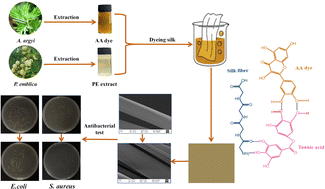
Graphical abstract: Eco-friendly dyeing of silk fabric by using Artemisia argyi as natural dye and Phyllanthus emblica as natural mordant

Article information

Article type
Paper
Submitted
14 Sep 2025
Accepted
10 Nov 2025
First published
11 Dec 2025
This article is Open Access
Creative Commons BY-NC license

RSC Adv., 2025,15, 49432-49440

Eco-friendly dyeing of silk fabric by using Artemisia argyi as natural dye and Phyllanthus emblica as natural mordant

L. Feng, A. Ye, X. Yu and Z. Chen, RSC Adv., 2025, 15, 49432 DOI: 10.1039/D5RA06947E

This article is licensed under a Creative Commons Attribution-NonCommercial 3.0 Unported Licence. You can use material from this article in other publications, without requesting further permission from the RSC, provided that the correct acknowledgement is given and it is not used for commercial purposes.

To request permission to reproduce material from this article in a commercial publication, please go to the Copyright Clearance Center request page.

If you are an author contributing to an RSC publication, you do not need to request permission provided correct acknowledgement is given.

If you are the author of this article, you do not need to request permission to reproduce figures and diagrams provided correct acknowledgement is given. If you want to reproduce the whole article in a third-party commercial publication (excluding your thesis/dissertation for which permission is not required) please go to the Copyright Clearance Center request page.

Read more about how to correctly acknowledge RSC content.

Social activity

Spotlight

Advertisements