


 PLATFORM UPDATE:


Enhancing the graphitization ability of corn-cob-derived lignin by coupling stabilization and hot-pressing
 a
Xiao
Han,
a
a
Xiao
Han,
a
Abstract
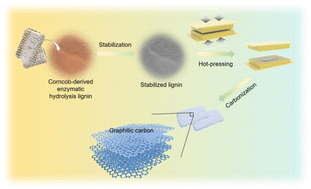
Lignin's non-graphitizable behavior is one of the key issues that impede its wide applications as carbon materials. Following our invention of using hot-pressing to facilitate lignin graphitization, this work focuses on converting an enzymatic herbaceous lignin which is less reactive and inherently contains long side-chains, and therefore follows a different pathway to graphitize compared with lignin from wood. This work presents more systematic investigation into the conversion of raw lignin to graphitizable carbon with better graphitic structure by stabilization and hot-pressing. Results show that lignin requires a suitable stabilization temperature to enhance its compressibility and high-pressure resistance, enabling its transformation into graphitizable structures. This work gives details in the characterization results of lignin, tracing its transformation from the raw state to carbonized samples, and elucidating the structural evolution during hot-pressing and carbonization. This study further identifies the optimal stabilization temperature as 320 °C, along with a hot-pressing temperature of 290 °C and a pressure of 18 tons at a low-carbonization temperature of 1000 °C. The carbonized LSHC-320-290-18 sample exhibits a significantly higher 2θ value of 25.26° at the (002) diffraction peak in the XRD spectrum.
 Please wait while we load your content...


