


 PLATFORM UPDATE:


Boosting energy storage density of lithium-ion hybrid capacitors via 3D graphene nanoflake integration

Abstract
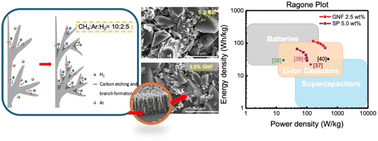
To meet the growing global energy demand across applications such as electric vehicles, mobile devices, and household electricity, lithium-ion hybrid capacitors (LIHCs) offer a more ingenious design than traditional lithium-ion batteries or supercapacitors, delivering superior performance in both energy and power density. The introduction of conductive additives into activated carbon-based electrodes is an advanced strategy to further enhance the performance of energy storage devices. In this study, we demonstrate the integration of 3D graphene nanoflakes (GNFs) into LIHCs to achieve promising charge storage characteristics. GNFs in this work were synthesized via an efficient and environmentally friendly approach and integrated into LIHCs as an additive. Unlike conventional chemical vapor deposition (CVD), the proposed plasma-enhanced CVD technique enables the synthesis of highly conductive GNFs with controlled surface area and 3D architecture at much lower temperatures (<300 °C) in just 10 minutes, without the need for toxic gases or additional catalysts. The as-synthesized GNFs possess a uniform open 3D network with high conductivity, structural stability, as well as intrinsic hydrophilicity. With the assistance of GNFs, the LIHC exhibited substantial improvements in both capacity and energy density. The device incorporating 2.5 wt% GNF achieved an impressive capacity of 62.35 mAh g−1, along with advanced energy density of 115.58 Wh kg−1. These results surpass LIHCs with commercial Super P and achieve higher energy density than most reported LIHCs with similar architectures and electrodes. The optimized LIHC even demonstrates energy densities beyond the conventional limits of LIHCs, entering the performance regime of lithium-ion batteries. This study provides a clean and efficient approach that paves the way for next-generation LIHCs, delivering excellent energy densities without compromising power density.
 Please wait while we load your content...


