


 PLATFORM UPDATE:


Research on the migration and transformation patterns of volatile pyrolysis products of WPCB by an online pyrolysis-mass spectrometry method
 a
Dongyin
Ren,
b
a
Dongyin
Ren,
b
Abstract
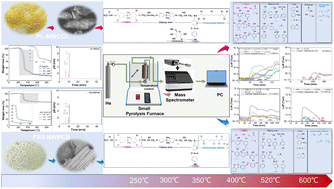
Understanding the release patterns of brominated and chlorinated flame retardants during the pyrolysis of different types of wasted printed circuit boards (WPCB) is of crucial significance for the resource utilization of WPCB. The non-metallic parts of copper-clad laminates with wood pulp paper as the substrate (PL-NWCCL) and the non-metallic parts of waste printed circuit boards with glass fiber as the substrate (FR4-NWPCB) were chosen as materials. Proximate analysis, elemental analysis, ion chromatography for oxygen and nitrogen, thermogravimetric analysis (TG), and Fourier-transform infrared spectroscopy (FTIR) were employed to analyze their composition, halogen content, pyrolysis characteristics, and functional groups. An on-line pyrolysis-mass spectrometry (Py-MS) system was designed to conduct dynamic and real-time monitoring of the pyrolysis volatile products of the two materials throughout the process, aiming to systematically explore the migration and transformation patterns of volatile product components during the pyrolysis of WPCBs. Online pyrolysis-mass spectrometry analysis reveals that during the pyrolysis of the two materials, the migration and transformation patterns of Br and Cl are different. In PL-WCCL, the cellulose induces a “delaying” effect on the release of Br and Cl. There are two distinct release phases within the primary weight-loss temperature ranges of 233–330 °C and 470–530 °C. In contrast, for FR4-WPCB, the release of Br and Cl remains unaffected by the substrate and is essentially complete within the primary weight-loss temperature range of 292–422 °C. By setting different isothermal holding periods during the pyrolysis process, the sequential release order of pyrolysis products can be ascertained. This further suggests that Cl· and Br· tend to bind preferentially with hydrocarbon radicals first and subsequently with H· radicals.
 Please wait while we load your content...


