


 PLATFORM UPDATE:


Carboxymethylcellulose functionalized magnetic graphene oxide for the efficient removal of tetracycline from aqueous media

Abstract
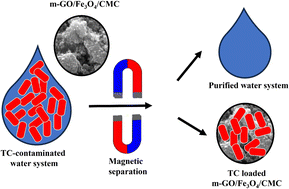
A carboxymethylcellulose (CMC) functionalized magnetic graphene oxide (m-GO/Fe3O4/CMC) nanoadsorbent was successfully synthesized to remove tetracycline (TC) in aqueous media. The prepared m-GO/Fe3O4/CMC nanoadsorbent was characterized using several instrumental techniques, including X-ray diffractometry, Fourier transform infrared spectroscopy, vibrating sample magnetometry, point of zero charge, transmission electron microscopy, scanning electron microscopy, and energy dispersive-X-ray. These techniques confirmed the successful synthesis of this nanoparticle and also revealed its superparamagnetic behavior, exhibiting a saturation magnetization of 50.69 emu g−1. The batch adsorption experiments were carried out under varying conditions, including adsorbent dosage, contact time, pH, initial concentration, and temperature, to determine the optimum conditions for the adsorption process. A maximum removal efficiency of 96.04% was achieved within just 25 min using a dosage of 0.1 g L−1 at pH 5. Kinetic analysis revealed that the adsorption followed the pseudo-second-order model, indicating that the uptake of TC was primarily governed by chemisorption. This behavior could be attributed to hydrogen bonding, electrostatic interactions, and π–π stacking between the adsorbate and the adsorbent. The isotherm data were best described by the Langmuir isotherm, with a maximum adsorption capacity of 54.73 mg g−1, suggesting monolayer adsorption dominated by electrostatic interactions on heterogeneous surface sites. Furthermore, reusability tests revealed the nanoadsorbent's excellent stability, retaining high adsorption efficiency even after ten consecutive cycles. The findings unambiguously demonstrated that this m-GO/Fe3O4/CMC nanoadsorbent could be a good choice to remove TC from wastewater sources.
 Please wait while we load your content...


