


 PLATFORM UPDATE:


Morphology-dependent synergy in high-performance MnO2/activated carbon electrodes via facile dry-mixing
 *b
*b
Abstract
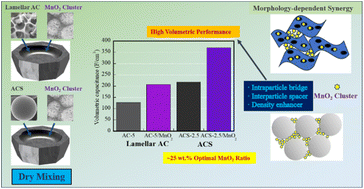
The pursuit of high-performance supercapacitors (SCs) often revolves around developing novel nanostructures through complex chemical synthesis, which poses challenges for scalable production. Herein, we demonstrate that exceptional electrochemical properties can be achieved by a simple dry-mixing of activated carbons (ACs) and manganese dioxide (MnO2). A series of ACs with distinct morphologies were prepared and composited with petal-like MnO2 clusters. We systematically investigated the profound impact of AC morphology on the synergistic effects with MnO2. The optimal hybrid electrode, comprising spherical carbon (ACS-2.5) and 25 wt% MnO2, delivered a superior gravimetric capacitance of 430.44 F g−1, a remarkable volumetric capacitance of 357.27 F cm−3 and an outstanding capacitance retention of 93.41 ± 0.23% after 5000 cycles. Furthermore, this electrode achieved an exceptional energy density of 14.96 Wh kg−1 at a power density of 61 W kg−1. Notably, the synergy was found to be highly morphology-dependent: a universal optimal MnO2 ratio of ∼25 wt% was identified for lamellar ACs, whereas the ideal ratio for spherical ACs increased with their diameter. Electrochemical impedance spectroscopy (EIS) and detailed mechanistic analysis revealed that MnO2 acts as a multifunctional agent, serving as an interparticle conductive bridge and intraparticle spacer, thereby drastically reducing charge transfer resistance and enhancing ion diffusion. Critically, the incorporation of MnO2 simultaneously increased the electrode compaction density, which is crucial for volumetric energy storage performance. This work provides fundamental insight into the structure–property relationship in hybrid electrodes and establishes a simple, scalable, and effective paradigm for designing high-performance energy storage devices by leveraging the synergy between conventional materials.
 Please wait while we load your content...


