


 PLATFORM UPDATE:


Simulated photovoltaic performance of N719 ruthenium dye sensitised solar cell with a power conversion efficiency exceeding 26% based on electron transport double layer

Abstract
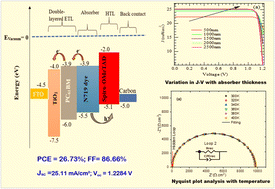
The advancement of modern technologies demands a balanced approach that addresses both environmental sustainability and economic viability. Accordingly, a transition towards renewable energy has become necessary. Among renewable energy options, solar energy is particularly appealing due to its widespread availability and ecological advantages. Dye-sensitized solar cells (DSSCs) offer an environmentally friendly and cost-effective alternative renewable energy. Their benefits include simple fabrication techniques, low-cost materials, and strong performance under low or diffuse light conditions. Herein, we investigate a promising solar cell device of the configuration, FTO/TiO2/PC61BM/N719/Spiro-OMeTAD/C, using SCAPS-1D device simulator. The model cell yielded remarkable photovoltaic parameters; power conversion efficiency (PCE) of 26.73%, open-circuit voltage (Voc) of 1.2284 V, short-circuit current density (Jsc) of 25.11 mA cm−2, and a fill factor (FF) of 86.66%. The relative permittivity of the materials used in heterojunction solar cells is often overlooked during the design of new material combinations. This work challenges this approach by studying the impact of permittivity on the physics and performance of solar cells through numerical simulations supported by analytical relationships. The results show that, depending on the cell configuration and material properties, the relative permittivity can have a significant effect on conversion efficiency, though its influence may sometimes be ignored without notable consequences. This work demonstrates that high permittivity materials should be prioritized as partners in the heterojunction with the absorber layer. The present configuration makes solar cells more robust against non-idealities, which are likely to occur in the early stages of development before full optimization of the device is realized.
 Please wait while we load your content...


