Issue 53, 2025, Issue in Progress

ALD-grown semimetallic TiSx for hole injection into monolayer WSe2

Abstract

Semimetal contacts have recently emerged as promising due to the remarkably low contact resistance of Bi and Sb to n-channel field effect transistors (FETs) prepared from two-dimensional (2D) transition metal dichalcogenide (TMD) semiconductors. However, hole injection in 2D semiconductors remains a bottleneck, hindering application of 2D devices in advanced logic nodes. In this study, we investigate the use of atomic layer deposition (ALD) to fabricate high work function semimetallic TiSx interlayers for efficient hole injection into WSe2, a 2D semiconductor of considerable interest due to its potential for next-generation scaled electronics. By employing ALD-grown semimetallic TiSx combined with capping the device with MoOx, we achieved a hole current of ∼64 µA µm−1 at VD = −1 V, a contact resistance of 10 ± 3 kΩ µm, and an ION/IOFF ratio exceeding 106 at room temperature. Hole injection may be favored because of a high work function and low density of states at the Fermi level of TiSx, promoting a low Schottky barrier to the valence band of WSe2, and by the van der Waals nature of the contacts. Performance is further aided by channel doping by MoOx.
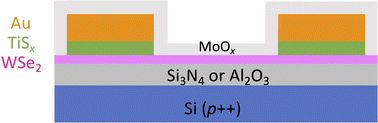
Graphical abstract: ALD-grown semimetallic TiSx for hole injection into monolayer WSe2

Supplementary files

Article information

Article type
Paper
Submitted
02 Sep 2025
Accepted
09 Nov 2025
First published
19 Nov 2025
This article is Open Access
Creative Commons BY-NC license

RSC Adv., 2025,15, 45417-45426

ALD-grown semimetallic TiSx for hole injection into monolayer WSe2

M. S. Rahman, C. Chiu and S. E. Mohney, RSC Adv., 2025, 15, 45417 DOI: 10.1039/D5RA06569K

This article is licensed under a Creative Commons Attribution-NonCommercial 3.0 Unported Licence. You can use material from this article in other publications, without requesting further permission from the RSC, provided that the correct acknowledgement is given and it is not used for commercial purposes.

To request permission to reproduce material from this article in a commercial publication, please go to the Copyright Clearance Center request page.

If you are an author contributing to an RSC publication, you do not need to request permission provided correct acknowledgement is given.

If you are the author of this article, you do not need to request permission to reproduce figures and diagrams provided correct acknowledgement is given. If you want to reproduce the whole article in a third-party commercial publication (excluding your thesis/dissertation for which permission is not required) please go to the Copyright Clearance Center request page.

Read more about how to correctly acknowledge RSC content.

Social activity

Spotlight

Advertisements